 English
  Русский
  Español
  Deutsch
  Français
  Українська
  Português (Brasil)
  Bahasa Indonesia
  Türkçe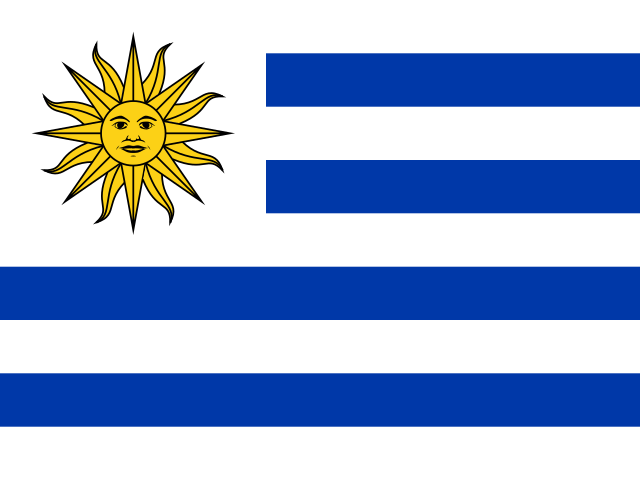
Uruguay
Tier 2Everything a marketer needs before entering Uruguay: economy, platforms, ad rules, payments and audience.
Economy & income
- Currency
- Uruguayan peso (UYU, $ or $U)
- ~40.3 UYU per USD (14 Jul 2026; 1 UYU ≈ $0.0248) — a floating currency, broadly stable/mildly strengthening across 2025–26. Note: locally the '$' sign means pesos, while 'U$S' denotes US dollars (widely used for real estate, cars & big-ticket items)
- GDP per capita
- ~$19,200 nominal (2025, IMF WEO est.)
- ~$34,300 PPP (2025, IMF DataMapper / World Economics) — the highest GDP per capita in South America and a World Bank high-income economy
- Average salary
- ~$915 net/mo (Numbeo, 2026; ~36,968 UYU average net salary)
- INE reports average personal income ~54,680 UYU (~$1,360/mo, 2025) across all income sources
- Median salary
- ~$990/mo (~40,000 UYU median personal income, INE Continuous Household Survey 'ECH', 2025) — median household income ~93,495 UYU (~$2,320)
- Minimum wage
- Salario Mínimo Nacional 24,572 UYU/mo (~$610) from 1 Jan 2026, rising to 25,383 UYU (~$630) from 1 Jul 2026 (+7.54% for the year) — the highest statutory minimum wage in USD terms in Latin America
- Cost of living
- Medium–High — the most expensive country in South America
- a single person needs ~$675–700/mo excl. rent (Numbeo, 2026)
- Montevideo is pricier than most regional capitals, driven by high taxes/utilities
Digital landscape
- Population
- 3.39 million (Jan 2025) — 95.9% urban (one of the most urbanised nations on earth)
- median age 36.4
- 51.5% female
- Internet users
- 93.0% (~3.15M users; 238K offline; +3.4% YoY) — among the highest penetration rates in Latin America
- fixed download ~160 Mbps
- Social media users
- 76.2% (~2.58M identities; 82.0% of internet users; 51.5% female)
- Mobile connections
- 7.18M cellular connections = 212% of population
- Devices
- desktop ~64.9% / mobile ~34.7% / tablet ~0.4% (StatCounter page-view share, Jun 2026) — StatCounter skews desktop-heavy here
- real content consumption is mobile-first
- Ad spend
- Digital ad spend ~$212M (2024, Statista Outlook) — ~6 of every 10 ad dollars now go online
- total ad market >11 billion UYU (2024)
- influencer advertising ~$9.4M (2024) → ~$14.3M by 2028
- Meta & Google capture the majority
- Top social platforms
- Messengers
- WhatsApp (dominant — de facto standard for personal & business chat)
- Facebook Messenger (~1.10M reach)
- Instagram Direct
- Telegram (niche, news/communities)
Ad regulations
RESTRICTED — State-controlled. Online sports betting & online lottery are legal ONLY through the state operator La Banca, run by the Dirección Nacional de Loterías y Quinielas (DNLQ); ~7 authorised concessionaires. Online casino is not yet fully regulated — a bill (passed the Senate, under debate in the Chamber of Deputies) would let only existing land-based casino licensees offer online games; tougher responsible-gambling/KYC rules took effect 2026. Foreign/private operators serving residents are unlicensed (grey)
LEGAL — Virtual Assets Law 20.345 (in force since late 2024) recognises virtual assets and places VASPs (exchange, custody, trading) under Central Bank (BCU) registration & AML supervision; crypto is NOT legal tender. Foreign firms need to register only if serving local users. BCU is issuing detailed secondary rules through 2025–26
LEGAL — Uruguay is socially liberal: sex work is legal and regulated as work (Law 17.515, 2002 — the only country in Latin America to formally regulate it; registration + health card via MSP). Adult pornography is legal for adults; pimping/commercial exploitation and CSAM are criminalised
ALLOWED — Mainstream dating apps operate freely; a secular, socially progressive, LGBT-friendly market (same-sex marriage legal since 2013, one of the earliest in the region)
RESTRICTED — Usury Law 18.212 caps compensatory & default lending rates (BCU publishes the maximum caps quarterly; the consumer-credit cap in pesos can exceed ~100% APR given inflation); charging above the cap is a crime and forfeits the excess. BCU supervises banks/finance houses; the MEF Consumer Defence area covers commercial credit & ad claims
RESTRICTED — Decree 18/989 (MSP): only OTC medicines may be advertised to the general public (ads must match the approved indications/doses and must not induce abuse/self-medication); prescription drugs may be promoted only to health professionals. Dietary supplements/vitamins are controlled and require MSP registration
- DNLQ (Dirección Nacional de Loterías y Quinielas — gambling)
- BCU / Banco Central del Uruguay (banking, VASPs/crypto, usury caps)
- MSP / Ministerio de Salud Pública (medicines, supplements, health ads)
- URCDP (data protection, Law 18.331)
- MEF – Área Defensa del Consumidor (advertising & consumer protection)
- Consumer relations governed by Law 17.250
- a strong data-protection regime (Law 18.331) is recognised as 'adequate' by the EU
- A stable, high-income, low-corruption market with strong institutions — advertising must avoid misleading claims and use Spanish-language labelling
Payments & behaviour
- Payment methods
- Debit cards (dominant — a government VAT rebate on card purchases actively pushes card use)
- Credit cards (Visa/Mastercard; local issuers OCA, Creditel)
- Mercado Pago wallet (~77% of digital-wallet volume)
- Bank transfer
- Cash-payment networks — Abitab & RedPagos (bill pay + cash-in for online purchases)
- E-wallets
- Mercado Pago (clear leader)
- Prex
- MiDinero
- Apple Pay / Google Pay (growing)
- bank apps (Itaú, Santander, BROU 'App BROU')
- Cash on delivery
- Low — a card- and digital-mature market
- classic cash-on-delivery is minor
- Abitab/RedPagos cash vouchers serve the unbanked and cash-preferring segment
- E-commerce
- High — ~74% of adults shop online
- sales surpassed US$4B in 2024, projected ~US$7B by 2027
- heavy cross-border shopping (Tiendamia proxy for Amazon/Walmart)
- Mercado Libre ~48% of online sales
- Notes
- Uruguay's financial-inclusion law + VAT rebate drove rapid card/wallet adoption
- Offer Mercado Pago + Visa/Mastercard at checkout, and add Abitab/RedPagos for cash users
- Debit is the everyday default
Audience & culture
- Languages
- Spanish (official, ~98% — Rioplatense 'voseo' Spanish, shared with Argentina)
- Uruguayan Portuguese / Portuñol (DPU — northern Brazil border: Rivera, Artigas)
- Uruguayan Sign Language (LSU — official)
- English (business & tourism; taught in schools)
- Religion
- The most secular country in the Americas — religiously unaffiliated ~52% (of whom ~17% atheist/agnostic and ~23% believe in a supreme being but follow no religion)
- Roman Catholic ~36–44% (declining)
- Evangelical/Protestant growing
- strict church–state separation since 1918 (Latinobarómetro 2023: 47% answered 'no religion')
- Median age
- 36.4 years (DataReportal, Jan 2025) — one of the oldest and slowest-growing populations in Latin America
- Key seasons
- Christmas & New Year / fin de año (Dec — peak spend; the 'aguinaldo' 13th salary is paid in two halves, June & December)
- Summer holidays & Punta del Este season (Dec–Feb — beach & luxury-tourism peak)
- Carnaval (late Jan–early Mar — the world's longest carnival, ~40 days)
- Semana de Turismo / Holy Week (Mar–Apr)
- Back-to-school (Mar)
- Black Friday & Cyber Monday (Nov — imported, growing)
- Cultural notes
- Calm, egalitarian, risk-averse middle-class society with high institutional trust and low tolerance for hard-sell or scammy creative
- Near-universal mate (yerba) culture
- football is a national obsession
- Strong Argentine cultural/media overlap (Rioplatense Spanish) means creatives usually travel across both markets
- Where to find creators
Media landscape
Top media outlets
- 1 El País (elpais.com.uy) Spanish — the leading daily and top news portal; centre-right, largest circulation and paper of record
- 2 El Observador (elobservador.com.uy) Spanish — business- and economy-focused daily with a strong, modern digital presence and in-depth reporting
- 3 Montevideo Portal (montevideo.com.uy) Spanish — a top digital-native news & entertainment portal with very high reach
- 4 Subrayado (subrayado.com.uy) Spanish — Canal 10's newscast, the #1 TV-news brand, plus a busy news portal & huge social video reach
- 5 Teledoce / Telemundo (teledoce.com) Spanish — a major broadcaster (Canal 12) with popular TV newscasts and online video
- 6 la diaria (ladiaria.com.uy) Spanish — subscriber-funded progressive daily; the weekly Búsqueda (politics/business/economy) is the key insider read
Top YouTube channels
- 1 Fede Vigevani (challenges, pranks & vlogs — most-subscribed Spanish-language YouTuber, Uruguayan) ~75M
- 2 YoSoyCactus (gaming & entertainment — top domestic-audience channel) ~17M
- 3 Yao Cabrera (controversial stunts/pranks — note: creator imprisoned 2024, brand-toxic) ~9.0M
- 4 Montevideo Music Group (music label — official videos & releases) ~1.6M
- 5 Lucas Sugo (popular Uruguayan singer — 'canto popular'/romantic) ~1.0M
- 6 El Reja (Uruguayan cumbia/plena artist) ~600K
Creators & public figures
Top creators

Celebrities






Affiliate & traffic
- Hot verticals
- iGaming / sports betting (grey vs the La Banca state monopoly — foreign operators)
- Nutra / health & beauty
- E-commerce & info-products (Hotmart)
- Finance / fintech, crypto & trading
- Dating
- Sweepstakes / mobile content
- Active networks
- Global CPA networks serving LatAm — Mobidea, AdCombo, Cpamatica, LeadBit
- Hotmart & Monetizze (info-products/courses — big across LatAm)
- Mercado Libre / Mercado Ads affiliate program
- Amazon Associates (cross-border demand via Tiendamia)
- Dr.Cash (nutra marketplace); iGaming/dating CPA networks (foreign-facing)
- Payouts
- LatAm Tier-2 (premium end): nutra COD ~$15–35
- iGaming ~$30–150 CPA/FTD (hybrid common)
- dating ~$1–4 CPL
- finance ~$3–12 CPL
- sweeps ~$1–5. CPMs run higher than most of LatAm given the affluence
- Competition
- Low–moderate — a small (~3.4M) but affluent, high-income and digitally mature Tier-2 market
- premium audience with high card/e-commerce penetration but limited scale
- Rioplatense Spanish creatives are shared with Argentina, extending reach
- Seasonality
- Q4 peak (Dec aguinaldo + Christmas + start of summer)
- betting spikes around the national team & major football (World Cup, Copa América)
- Punta del Este summer luxury season (Dec–Feb)
- Black Friday/Cyber in Nov
- Traffic sources
- Meta (Facebook / Instagram) Ads
- Google Search & YouTube
- TikTok Ads
- Push & native (RichAds, PropellerAds, MGID)
- Influencer / creator collaborations
Good to know
- Capital
- Montevideo
- Major cities
- Montevideo (~1.32M city / ~1.9M metro — roughly half the country)
- Salto (~105K)
- Ciudad de la Costa (~112K, Canelones)
- Paysandú (~76K)
- Rivera (~78K, Brazil border)
- Las Piedras (~72K)
- Maldonado–Punta del Este (~90K+, resort hub)
- Tacuarembó (~55K)
- Time zones
- Single zone — Uruguay Time (UYT, UTC−3)
- no daylight saving (DST abolished in 2015)
- Android vs iOS
-
Android 67% iOS 33%
- Phone brands
- Top e-commerce
- Mercado Libre (mercadolibre.com.uy — #1, ~48% of online sales)
- Tienda Inglesa (tiendainglesa.com.uy — supermarket e-commerce)
- Tiendamia (cross-border proxy for Amazon/Walmart)
- Amazon (cross-border)
- Devoto / Disco (grocery)
- electronics retail (Loi, Frávega)
- Temu / Shein (surging cross-border)
- Peak activity
-
Weekday evenings ~20:00–24:00 UYT (late Rioplatense dining/leisure rhythm), with a lunch ~13:00–15:00 bump; heavy weekend browsing🕐 In your time zone (approx.):
- Creative taboos
- Politics is consensual and low-drama — avoid polarising US-style culture-war framing
- respect the country's strong secularism (don't lean on religion)
- the 1973–85 dictatorship era is a sensitive memory
- steer clear of aggressive hard-sell (audience is scam-wary and consumer-protection-minded)
- Also worth knowing
- Small (~3.4M) but the wealthiest, most bankarised and most digital market in South America — premium CPMs, high card/e-commerce use and low fraud.
- Rioplatense Spanish and media overlap with Argentina — creatives usually carry across both.
- The aguinaldo (13th salary, paid in June & December) creates two clear spending bumps.
- iGaming is a state monopoly (La Banca) — route betting offers carefully.
Indicative reference — always confirm the current rules with the official source before you run.